
Silver Run Tackle
When to Use Each Salmon Spinner Color
Match water clarity and light to Pink, Green, Blue/White, Purple/Pink, Chartreuse, and Red — a practical rotation for 1 oz inline salmon spinners.
Color on a salmon spinner is a visibility choice, not a lucky chart. Match the day’s water and light, then fish the pattern long enough to know if it is working. Depth, blade spin, and retrieve still matter more than paint — a stalled lure in the wrong lane will not get better because it is pink. This guide is the rotation system for Silver Run Tackle’s six 1 oz colors: Pink, Green, Blue/White, Purple/Pink, Chartreuse, and Red.
For how an inline spinner actually works in current, see How Inline Spinners Catch Salmon in Heavy Current. For cadence once the lure is at depth, see Best Retrieve Speed for Salmon Spinners. The same color logic applies to other honest river spinners — Mepps, Blue Fox, Worden's, and similar hardware. SRT is one kit built around those six jackets.
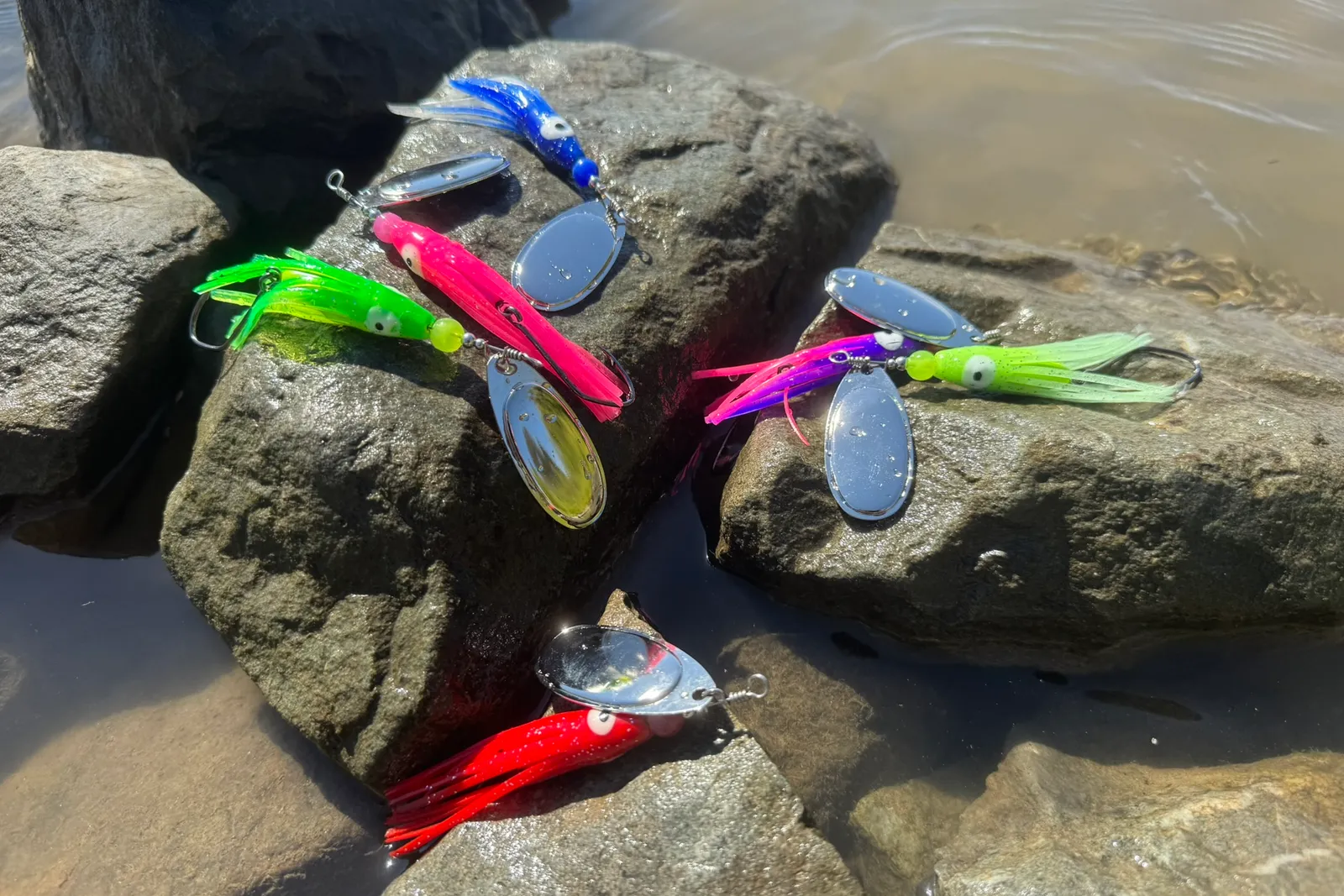
Table of Contents
Why Color Matters in a River
River salmon are not sitting in a clear aquarium. Light hits the surface, then water, sediment, and tannin eat it. What you see on the bank is not what a fish sees at travel-lane depth. Color still matters — it changes how far the lure stands out against the column — but it is contrast and brightness more than a perfect baitfish clone.
Contrast Versus Hue
In clear water, fish get a longer look. A natural profile with honest flash can look like something that belongs there. In stained water, they get a shorter look. Hue is less useful than whether the lure pops against a brown or gray background. That is why a “loud” color that looks cartoon on the grass can be the one fish track through a dirty slot.
Think in two jobs:
- Clear, bright columns: Do not overpower. Let blade flash and a quieter body do the work.
- Stained, murky, or flat light: Give the fish something to find — brighter paint, stronger two-tone, or a hard silhouette.
Body Color Versus Blade Flash
An inline spinner is a jacket around a spinning blade. Water turns the blade. That rotation throws flash and a pulse fish feel through the lateral line. Powder-coated body and hoochie color are the jacket — easier or harder to see depending on the column. If the blade is not spinning, the jacket does not matter.
Fish the hardware first: sink, track, and a steady thump. Then use color to match how far you need the lure to show up. Same 1 oz torpedo, same Siwash, different jacket when clarity or sky changes.
What Light Does to Red, Green, and Chartreuse
Water is a filter. In relatively clear columns, longer wavelengths — the reds you see on the bank — drop out first as depth increases. A red lure can still be useful, but often as a dark, high-contrast shape rather than the fire-engine red in the tackle box. Green and blue-toned profiles tend to hold their identity longer in that same clear water. Fluorescent yellow-green (chartreuse) is popular in stained and green water because it stays bright when ordinary paint goes muddy — it is high-vis, not a hatch match.
Stained rivers are not the open ocean. Dissolved organics and sediment scatter light and can shift which wavelengths survive. Do not treat a scuba-depth ocean chart as a river rule. Use it as a reminder: at depth, contrast often beats the color name on the bag. Hedge every “always” statement. If the lure is tracking and you can still see it at knee depth in the current you are fishing, you are in the right neighborhood.
How to Choose: Clarity, Then Light
Pick color in order: water first, sky second, fish mood third. Skip the mood step until the lure is actually in the lane. Most “wrong color” days are wrong depth or a dead blade.
Read the Water First
A practical field test: dunk the spinner — or just look at a boot or rock — at about knee depth in the flow you will fish.
- Clear: You can see the lure’s color and hardware. Start Green or Blue/White.
- Stained: You see a shape and some color, but edges fuzz. Start Pink, Purple/Pink, or Red.
- Murky: The lure disappears in a foot or two, or the river looks like coffee with cream. Start Chartreuse (Red if you want silhouette more than neon).
After rain, snowmelt pulses, and tide-stained lower rivers all slide you toward the brighter set. When the column drops and greens up, step back toward Green or Blue/White. You are matching today’s visibility, not last week’s rumor.
Then Read the Sky
Bright sun on clear water is the quietest jacket. Overcast takes the sparkle off the blade, so a little more body color helps. Dawn, dusk, and canyon shade are low-light problems even when the water itself is decent — Purple/Pink and Pink earn those hours more often than a pale baitfish pattern.
If the sky and the water disagree, trust the water. A stained river on a sunny day still wants contrast. A gin-clear run under gray cloud can still want Green — just be ready to bump to Pink if follows stop short.
Then Fish Mood
Some days they eat neon. Some days chartreuse looks like a construction vest and they slide off it. That is the Pink job: stained water when you still want bright, but softer than chartreuse. Red is the other fork — hard color for fish that track a bold profile in current instead of a pastel flash.
Mood is the last knob, not the first. Change it after a fair swing, not after two casts because a guy upstream is on a different color.
A Starting Chart
Use this as a first lure, not a promise. Fish the color thoroughly before you rotate.
| Water | Bright sun | Overcast | Low light |
|---|---|---|---|
| Clear | Green or Blue/White | Green; Pink if they ignore it | Purple/Pink or Pink |
| Stained | Pink or Red | Pink, Purple/Pink, or Red | Purple/Pink or Red |
| Murky | Chartreuse or Red | Chartreuse | Chartreuse; Red for silhouette |
Green and Blue/White
These two are the clear-water pair. Same job — do not blow up a clean column — different jackets. Keep both if you fish bright rivers a lot; one is enough if you mostly see stain.
When Green
Reach for Green in clear water and bright conditions when a natural profile still needs flash. Green reads as something that could live in the river — plant, bait, or just “not neon” — while the blade still throws light. It is the default on a high, clear morning when you can see gravel and the spinner at the end of a short swing.
Stay with Green while the water stays honest. If the sun is high and fish are looking, a quieter body often gets a cleaner eat than a highlighter. If you are marking follows that never close, that is a speed or depth problem first. If those are already right, then try Blue/White for a cooler two-tone, or step to Pink if the light has gone flat.
When Blue/White
Blue/White is the other clear, sunny option: baitfish flash without going too loud. The two-tone gives a little extra contrast against a bright sky reflection — a pale belly suggestion — without the punch of pink or chartreuse. Use it when the water is clear, the sun is up, and Green feels a little too “one note,” or when you simply fish better with a baitfish look in your head.
It is not a dirty-water lure. If you cannot see the white on the body at knee depth, move to the stained set. Blue/White shining in chocolate water is mostly for you, not for the fish.
How to Fish Them
Clear water punishes sloppy retrieves more than loud paint. Count the sink. Start the retrieve only fast enough for a steady blade. In push, current will do a lot of the spinning — you are steering the path, not burning the handle. Cast across or slightly upstream so the lure loads into the seam instead of skating.
Give the color a full pass through the water you believe holds fish: inside seam, mid-column swing, and the tailout if the run has one. Do not change jackets every cast. If the blade is thumping and you are not riding high, the fish have seen the color. That is when a change means something.
When to Leave Them
Step off Green and Blue/White when the column dirties, the sky goes heavy gray, or you are fishing the first and last hour in shade. Those are Pink, Purple/Pink, Red, or Chartreuse hours. Come back to the clear-water pair when the river drops and greens and you can see the lure again.
Pink, Purple/Pink, and Red
These three cover stain and low light. All of them show up better than Green when visibility drops. They are not interchangeable: Pink is the softer bright, Purple/Pink is contrast without neon, Red is the hard color.
When Pink
Reach for Pink in stained water when fish want a softer bright instead of neon flash — overcast banks and days when chartreuse feels too hot. Pink is the workhorse “they can find it” color that does not look like a tennis ball. If the river has color but you can still see a boot at the knee, start here more often than Chartreuse.
Pink also bridges a clear morning that turns stained after wind or tide. You already know the run. Swap the jacket, keep the same sink and cadence. If Pink gets looks but no commit, try Purple/Pink for more contrast or Red for a bolder profile before you jump all the way to chartreuse.
When Purple/Pink
Purple/Pink is contrast for stained water and low light when you want color without chartreuse. The darker purple reads as a silhouette; the pink keeps a bright edge. That pairing is useful at dawn, in canyon shade, and in stain where a single pastel can wash out.
Fish it when the light is the problem as much as the water — gray ceilings, rain, the hour after sunset if you are still legal. If the river is truly muddy, Chartreuse still wins on raw visibility. If the river is stained and the day is dark, Purple/Pink is often the better first pull.
When Red
Red is bold flash for stained water and aggressive fish that track hard color in current. Use it when you want a strong profile — not a soft glow. Some days they want that; some days they do not. Give it a fair swing in stain before you decide.
Remember the optics hedge: in clearer, deeper columns, red can lose the hue you see on the bank and show up more as a dark shape. That is not a reason to leave it in the box. A hard silhouette is a legitimate trigger in current. In stain, you are mostly buying contrast anyway. Do not expect bank-red at 12 feet in gin water; do expect a lure fish can separate from the background when the river has color.
How to Pick Among the Three
Start with one, not a carousel:
- Pink — default stained/overcast bright; chartreuse would be too hot.
- Purple/Pink — low light, or stain where you want a darker back and a bright edge.
- Red — hard color; fish that seem willing to chase a bold profile.
Fish that choice through the seam. If nothing happens and you trust depth and speed, then rotate inside this group before you burn the whole box. Pink to Purple/Pink is a small step. Jumping from Green straight to Chartreuse is a big one — sometimes right after a mud pulse, often too loud if the water is only lightly stained.
Chartreuse When the River Goes Dirty
Chartreuse is the high-vis tool, not the all-day default. The shop SKU is Chartreuse/Glow — treat it as the loud yellow-green jacket for murky runs and overcast, not as a night-bite gimmick. If you cannot see the lure, they probably cannot see a subtle one either.
Murky Runs, Heavy Overcast, After Rain
Throw Chartreuse when the river goes dirty: cream coffee, sloppy after rain, or a sky so flat the blade flash dies. High-vis paint helps the lure remain a bright spot in scattered light. Pair it with honest weight and a slow, loaded retrieve. In mud, vibration does as much work as color — keep the blade turning.
After a blowout, Chartreuse is a search color. Cover water. If the column starts to drop by afternoon, you can step back to Pink without changing anything else about the swing.
When Chartreuse Is Too Loud
Clear water plus chartreuse is a common miss. Fish get a long look at something that does not belong. If you are marking boils or follows that turn off, put the highlighter away and go Green, Blue/White, or Pink.
The other miss is living on Chartreuse because it caught one last October. Some stained days they want Pink. If Chartreuse gets ignored in water that is only moderately off-color, that is the “softer bright” cue. Step down, do not step up.
How Long to Fish a Color Before You Switch
Give a color a fair swing through the water you came to fish — not every other cast, and not one pass while you are still finding depth. Change jackets only after the lure is tracking: blade thumping, not skating, not ticking bottom every crank. Weight and cadence come first; see Why Fish a 1 oz Inline Spinner? if the lure will not stay in the lane.
A useful rule: one color through a run (or a full bank of casts from one stance) before you rotate. If you move to a new seam, you can keep the same color until the water or light actually changes. Rotating every cast teaches you nothing. You never know whether the last fish ate Pink or finally saw a spinner at the right depth.
Sample day, not a script: clear bright morning on Green or Blue/White. Wind or a tide line stains the column — swap to Pink. Sky dumps and the river turns, or you cannot see the lure at the knee — Chartreuse. Evening shade on still-decent water — Purple/Pink. Same spinner class, different jacket. Confidence in the one you commit to usually beats a box you never settle on.
What to Carry
You do not need six rods. You need a short kit that covers the column you actually fish:
- One clear-water color: Green or Blue/White.
- One stained-water bright: Pink, Purple/Pink, or Red — pick the one you will fish carefully.
- Chartreuse for dirty water and heavy overcast.
That trio handles most river days. Add the rest when you fish water that changes twice before lunch, or when you want Pink and Purple/Pink without guessing on the bank. The SRT 6 pack is one of each official-release color plus a Plano 3500 — the no-guess version of this kit.
Common Color Mistakes
Blaming color when the blade is dead. If you do not feel a thump, fix sink, angle, or retrieve before you touch the box. Paint cannot save a spinner that is skating or stalled.
Matching the hatch too hard on a spawning-run Chinook. River salmon are not always feeding like trout on a mayfly. Aggression and a lure that invades the lane often beat a perfect baitfish clone. Natural Green and Blue/White still belong in clear water — they just are not the only story. Bright Pink can outfish a “correct” herring look on a stained afternoon for that reason.
Never leaving Chartreuse — or never trying it. Living on high-vis in clear sun is as much a miss as leaving it in the truck after a mud pulse. Match the column in front of you. Step down when they refuse neon; step up when the lure vanishes at the knee.
Rotating every cast. You need a sample size. One color, honest depth, a real swing. Then change.
Further Reading
Color choice on the river is still practice and confidence. These sources are the optics and vision backdrop — not a lure chart.
- NASA PACE — Light and the ocean (red absorbed near the surface in clear water; not a river-depth lookup table)
- University of Hawaiʻi — Light in the ocean (wavelengths drop out at different depths; red objects can read dark)
- PLOS One — Atlantic salmon photoreception during smoltification (salmonid vision is real and it changes with life stage; it is not a Chinook river-color recipe)
FAQ
What color spinner should I use in clear water?
Start with Green or Blue/White. Both are cooler, cleaner profiles for clear water and bright days — Green when you want a natural flash, Blue/White when you want baitfish two-tone without going loud.
What color spinner for stained or dirty water?
Start with Pink, Purple/Pink, or Red when the water is stained or the light is low. Reach for Chartreuse when the river goes murky or the sky is heavy overcast.
When should I throw pink instead of chartreuse?
Use Pink when you want a softer bright — stained water, overcast banks, and days when neon chartreuse feels too hot. Switch to Chartreuse when visibility collapses and you need high-vis flash.
Does red still show at depth?
Often as contrast more than as the red you see on the bank. In clear water, longer wavelengths fade first, so a red body can read as a dark silhouette deeper in the column. In stained rivers, hue matters less than whether fish can find the lure — which is why bold red still earns casts when the water has color.
How often should I change spinner colors?
After a fair swing through the seam with honest depth and blade speed — not every other cast. Change color only after you know the lure is tracking. The color you fish carefully usually beats the one you keep rotating.
Do I need all six salmon spinner colors?
A kit of three covers most days: one clear-water color (Green or Blue/White), one stained-water bright (Pink, Purple/Pink, or Red), and Chartreuse for dirty or flat-gray water. Carry all six if you fish rivers that change clarity from morning to afternoon.
Match the jacket to the column, then fish it. Browse Pink, Green, Blue/White, Purple/Pink, Chartreuse, and Red on the shop — singles or the six-color pack.